Showing posts with label clamping. Show all posts

Wednesday, November 19, 2014

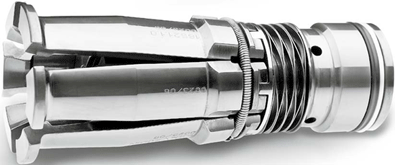
Berg Clamping systems Tool Clamping - SSKV

Application
Berg SSKV gripper are primarily designed for drawing in and ejecting steep taper tooling provided with retention knobs internationally standardized as per DIN, ANSI, MAS, JIS and ISO which allow fast automatic tool changes. Actuation is mechanical, hydraulic, electro-mechanical
or pneumatic.


Design features
SSKV clamping sets have six collets held by an annular spring which allows a rocking movement for clamping the steep taper tools. During clamping the taper of the centrally positioned drawbolt increases the actuation force, thereby generating a much higher clamping force at the collets. The special tribolic coating guarantees the highest possible
constant clamping force. The clamping set is maintenance free. A locking bolt permits infinitely variable positioning and fixation of the clamping set in the Z axis. No special tools are required for assembly and disassembly.

#workholding

Sunday, August 10, 2014

Berg clamping systems SK-Steep Taper Tooling


TOOL Clamping systems and release systems
Depending on the selected clamping set type and the machine requirements complete clamping and chucking systems are available in combination with the various actuation elements.
The following chart is provided for the purpose of allocation and selection. The actuation devices are described and depicted in detail in the specific data sheets. Please contact us for more information for clamping and release systems which are not detailed.
Gripper Clamping cylinder, rotating Multi-energy supply, stationary
Spindle speed nmax. <4000 rpm <15000 rpm > 15000 rpm
Features / Type ESK OHLK OHL SEK SE
Clamping Electrical Hydraulic Hydraulic Mechanic Mechanic
Releasing Electrical Hydraulic Hydraulic Mechanic Mechanic
Spindle bearing relieved
Position control
Compressed air supply
Cooling lubricant supply
Gripper Clamping cylinder, rotating
Spindle speed nmax. > 15 000 rpm
Features / Type HDZ HLZ HLZE
Clamping Mechanic Mechanic Mechanic
Releasing Hydraulic Hydraulic Hydraulic
Spindle bearing relieved
Position control Optional Optional Optional
Cooling lubricant supply Optional Optional Optional

Friday, August 30, 2013

GMT Power Operated Quick Change Jaw Chuck


The range of our PHNC Chucks is medium. PHNC is meant to provide a high speed range. Power OperatedQuick Change Jaw Chuck really  provides a super high speed range. The machines of the immediate feature will require very high speed range of speeds without almost any loss of clamping pressure at high speed.

CNC Lathes are used particularly to machine small and medium sized batches. This involves frequent change over of the chuck jaws, which can be accomplished without undue cost by using chucks with quick change jaws.

GMT has designed a power chuck with a quick change jaw system. This chuck helps in reducing the jaw changing time to a minimum. The wedge bars are designed to help counteract the effects of centrifugal force, and in fact this is done by setting them into the angled pockets in  the body of the chuck. Moreover, the angles chosen by GMT for the piston shoulders and wedge bar teeth provide high mechanical efficiency ratio that provides for both sensitive and high pressure clamping.

To withstand the most arduous working conditions, all PHQC chucks are designed with a high factor of safety. PHQC Chucks are operated by means of rotary cylinders controlled by proximity switches that provide signals concerning the state of the chuck i.e. clamping or declamping.

WORKING
This power chuck is different from other chucks. Its quick change jaw system has the inherent advantage for rapid resetting or changing of the gripping jaw. It is only necessary to release an eccentric locking pin with a special hexagonal key in each of the jaws keeping the chuck stationary. This disengages the gripping jaws, which can then be -reset to the required gripping diameter or can be reversed or can be replaced by a jaw from another set. Turning the key again reengages the gripping jaw and enables the key to be withdrawn and this operation provide great reliability.

PHQC chucks offer an effectively simple but technically advanced design to satisfy the high demands in both production and safety and modern machining. In addition the chuck offers a genuinely quick change jaw system with a speed and strength combination compatible with increased production and safety.

Wednesday, July 31, 2013

GMT Twist Finger Chuck


FINGER CHUCK : GMT has developed specialized chucks for second operations where radial clamping is not possible. A suitable locator is used to locate the component center. The fingers located in a rod, which has a helical groove ensure that the component is flat against the chuck. This enables loading yet ensures accurate location. GMT-make hydraulic rotating cylinder is used to move the chuck fingers swings in and clamps the component in a single motion. Actuator pin is located on helical groove for actuating the finger. Fingers during de-clamping lift and swings out for component unloading and loading. The chuck firmly clamps the component without any distortion or surface damage.
Features :
  • Chuck has a locator for locating the component.
  • Twist finger chucks cannot perform without locating the component.
  • Fingers are located in a rod, which has a helical groove.
  • Actuator pin located on helical groove for actuating the finger. Fingers during clamping and de-clamping lift, swings in and out, for component loading and unloading.
Application :
Automotive, Wheel turning, Aerospace, Aircraft, Commercial vehicles, Energy, Heavy duty machines, Defence Production, Oil, Wind generators

Friday, June 21, 2013

Chuck Lubrication: What can go wrong if ignored?

What if you don’t lubricate as per schedule and don’t use the right lubricant?

 Improper lubrication results in;
  • Loss of Gripping Force
  • Component Slippage
  • Clogging, restricting lubricant flow and Jaw Stroke
  • Corrosion  

If the chuck is not lubricated regularly, the chuck body, wedge and the sliding parts will get corroded, resulting in high friction and loss of clamping force. The curve of the clamping force of a new lathe chuck, depending on the RPM, shows as a continuous curve. An improperly lubricated lathe chuck, shows a considerably reduced clamping force and shows as a dashed curve. This result in unsafe clamping of the work piece and the chances of falling out during machining is high. To avoid this, follow the lubrication and maintenance instruction provided in the chuck instruction manual. 

GMT recommends you to slide the master jaw through full stroke (clamping and de-clamping) to ensure uniform distribution of grease on sliding surfaces several times, without the component, after 500 jaw cycles. This helps to convey the lubricant to the sliding faces and maintain the clamping force longer.

For lubricating the lathe chucks, GMT recommends one of the following grease:
·         OKS  265            
·         ALTEMP  QNB50
·         MOLYKOTE  TP42

GMT chucks are equipped with several lubrication nipples for even application of grease. To ensure  even distribution of the grease inside the chuck, slide the master jaw through full stroke (clamping and de-clamping).

Remember, in extremely contaminated environment such as machining C.I work pieces a chuck can lose clamping force. In such cases, the complete chuck has to be disassembled, cleaned and lubricated. 

Chuck  with improper or no lubrication causes corrosion as shown in the photos below

                                                 CHUCK BODY                       BODY SLOT


                                                  WEDGE                                    BASE JAW

Write to us at esales@gmt.co.in for a free electronic copy of GMT Instruction Manual or visit our website www.gmt.co.in for more information